
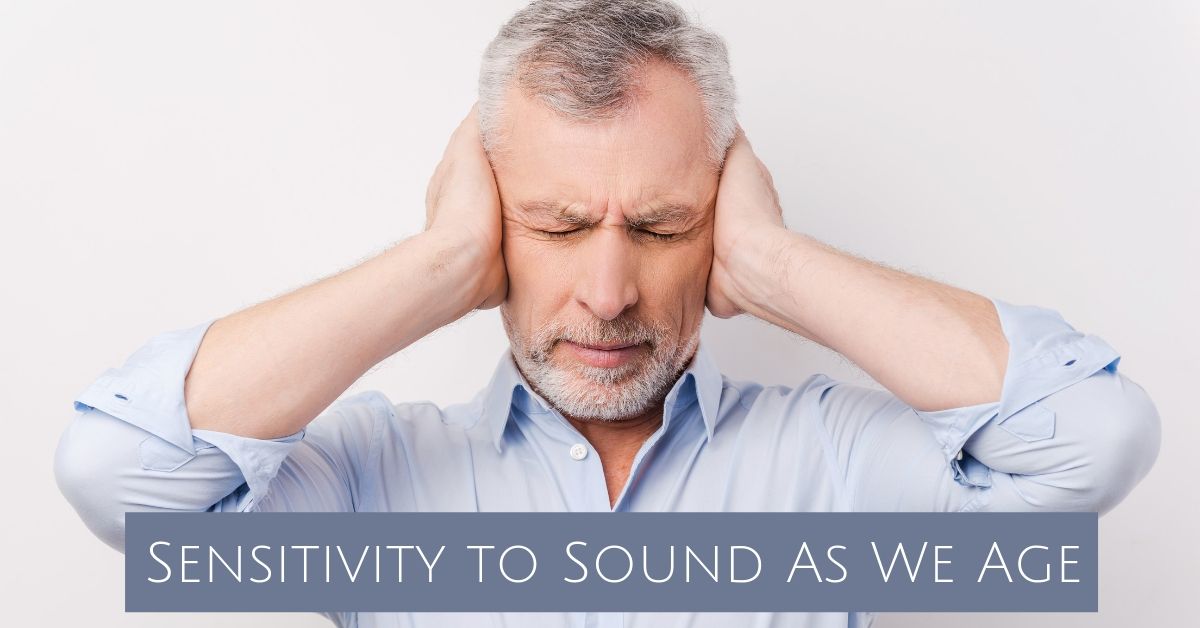
It probably doesn’t surprise you to learn that our hearing changes as we age. Hearing loss becomes more common with age, often because of the combined effects of aging and noise exposure over a lifetime. But our hearing changes in other ways as well. Research from Canada, published in 2018 in The Journal of Neuroscience, suggests that aging may affect our ability to filter out background noise, making us more sensitive to intrusive sounds and affecting our acuity with focus and following speech.
New Research Emerging
A team at Canada’s Western University measured brain responses to sound in adults in their 20s and in their 60s, all with clinically normal hearing. They looked at how the auditory part of the brain adjusts in environments with both loud and soft sounds. In younger participants, the brain adapted to loud surroundings by becoming less responsive to quiet, irrelevant sounds, which can help with focusing on what matters. The older group had a much different reaction to the same sounds. In older participants, the brain stayed more sensitive to quiet, irrelevant sounds. The researchers described this as an over-sensitivity to sound and suggested it may help explain why older adults often find noisy places like restaurants distracting.
Over-Sensitivity to Sound
An over-sensitivity to sound can result in changes to our social behavior, sometimes in ways similar to hearing loss. A decreased ability to prioritize important sounds and an increased level of distraction by background noises can dramatically change the way we experience and appreciate the world around us.
Over-sensitivity, for instance, can make big social and public events frustrating rather than enjoyable. It can affect attention and concentration, and leave a person feeling irritated by intrusive noises rather than immersed in the activity. Similarly, over-sensitivity can make spaces more confusing to navigate as different sounds vie for attention. As a result, over-sensitivity to sound can make social activities less enjoyable, and makes over-sensitive people more prone to avoid noisy environments.
Hearing Loss and Social Activity
Hearing loss also can result in changing social behavior. Untreated hearing loss makes it harder to comprehend others, especially in locations that are loud and noisy. It can also make familiar activities feel lackluster and new places feel disorienting. Hearing difficulty often negatively impacts our experiences in the world and makes them more difficult to participate in.
Like over-sensitivity, this side effect of hearing loss can result in a drop off in our social activities. Places, events and occasions that were once a part of our life and community may fall to the wayside because of hearing loss.
Hearing Loss and Social Isolation
When our social activity is curtailed by hearing loss, we may become more susceptible to isolation, depression and anxiety. Social isolation happens when ties to friends, family and community weaken, and it has been linked with physical and mental health problems.
Research has linked social isolation with a higher risk of depression, anxiety and dementia, although these studies show associations rather than proof of cause. The lack of mobility and connection that isolation results from makes it difficult to break out of. Isolation can be the result of anxieties produced by hearing loss, conditioning a person away from social activity.
Over-Sensitivity and Hearing Loss
Unfortunately, being over-sensitive to sound doesn’t negate hearing loss. The two conditions are often found together. Over-sensitivity simply means that it is difficult to prioritize the sounds you hear, while hearing loss means that your ability to hear a full range of sound is reduced.
The two conditions can operate in conjunction with each other, making compromised hearing even more challenging in noisy locations. Increased over-sensitivity to sound as we age may explain some of why adapting to hearing aids and assistive devices can initially be challenging and might shape the way hearing technology is approached moving forward.
The Atlanta Hearing Doctor
It is important to care for your hearing as you age and stay on top of issues such as hearing loss and over-sensitivity. How do you start? The Atlanta Hearing Doctor is ready to help you set up your first appointment. Regular hearing exams help find and address issues early, before deeper problems can take root. At The Atlanta Hearing Doctor we focus on your personalized hearing care from comprehensive testing to tailored hearing solutions, we’re ready to get your hearing health on track, so contact us today!

About The Atlanta Hearing Doctor
Audiologist Dr. Maria Wynens has served patients since 1988 and provides hearing care from our office in Sandy Springs.
About Dr. Wynens





